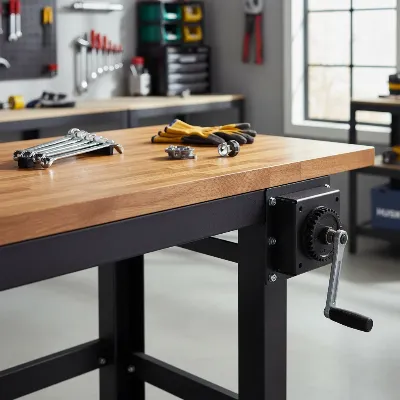
Every serious DIYer or professional knows the value of a well-equipped workshop. Among the essential power tools, a bench grinder stands out for its versatility in sharpening, shaping, and deburring metal. However, the true potential and safety of this machine are unlocked only when it is firmly anchored to a stable workbench. An unsecured bench grinder can vibrate excessively, move unexpectedly, or even tip over during operation, posing significant hazards and compromising the quality of your work. This comprehensive guide will walk you through the essential steps and considerations for securely attaching your bench grinder, transforming it from a potential danger into a reliable cornerstone of your workspace.
Why a Securely Mounted Bench Grinder is Essential
The importance of securely mounting your bench grinder cannot be overstated. A stationary grinder provides the stability needed for precise work, whether you are sharpening a chisel, deburring a metal edge, or shaping a component. Without a firm connection to your workbench, the rotational force of the grinding wheels can cause the machine to shift, vibrate erratically, or even fall. Such movements not only lead to inaccurate results but, more critically, can result in severe personal injury, including lacerations, abrasions, or eye damage from uncontrolled sparks and flying debris. Industry safety standards, such as those from OSHA, consistently emphasize that fixed machinery like bench grinders must be securely anchored to prevent movement during use, highlighting that stability is paramount for safe operation. Beyond safety, a securely mounted grinder simply works better, offering improved control, reduced fatigue, and ultimately, greater productivity in your workshop.
Tools and Materials You’ll Need
Successfully attaching your bench grinder requires a few basic tools and materials that you likely already have or can easily acquire. Gathering everything beforehand will streamline the process and ensure you can complete the installation efficiently and safely.
- Bench Grinder: The star of the show, ready for mounting.
- Measuring Tape or Ruler: For precise positioning and measurements.
- Pencil or Marker: To mark drilling points accurately.
- Drill and Drill Bits: Select bits appropriate for the size of your mounting bolts and the material of your workbench. Typically, a wood bit for a wooden bench or a metal bit for a metal-clad surface.
- Wrench or Socket Set: To tighten nuts and bolts securely.
- Bolts, Washers, and Nuts: Choose bolts that are slightly longer than the combined thickness of your grinder’s base and workbench top. Flat washers should be used under both the bolt head and the nut to distribute pressure and prevent damage. Lock washers or self-locking nuts can add extra security against vibration. Alternatively, lag screws can be used for wood workbenches if you prefer not to drill all the way through, or T-nuts for a flush finish on the underside.
- Safety Glasses and Hearing Protection: Non-negotiable for any drilling or grinding task.
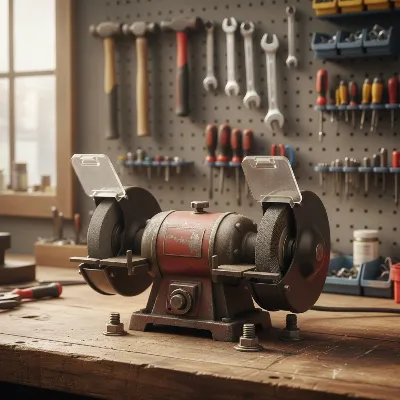 A securely mounted bench grinder on a sturdy wooden workbench, with clear workspace around it, highlighting stability and readiness for use.
Step-by-Step Guide to Attaching Your Bench Grinder
Attaching a bench grinder is a straightforward process, but it demands attention to detail, especially regarding safety and precision. Follow these steps for a secure installation.
Prioritize Safety: Before You Begin
|
Our Picks for the Best Work Bench in 2026
As an Amazon Associate I earn from qualifying purchases.
|
||
| Num | Product | Action |
|---|---|---|
| 1 | Heavy Duty Workbench Bracket Kit - 8 Pcs Steel 3-Way Right Angle Corner Brackets for DIY Custom Workbench, Shelving, Work Table, Fits 2x4 (Actual 1.5"x3.5") Wood |

|
| 2 | Seville Classics UltraHD 72" W X 25" D Wood Top Height Adjustable Workbench 2000 Lb Capacity |
|
| 3 | Express Folding Work Table, Easy Setup Portable Folding Work Table & Portable Folding Workbench, 34" W x 25" D x 31" H Lightweight Versatile Clamping Worktable for Garage/Wood Shop (Black) |
|
| 4 | Foldable Work Bench,Easy Step Protable Work Table,34" W x 25" D x 31" H Lightweight Workbench wih 1650 LBS,Work Benches for Garage,Work Bench Suitable for Garage,Workshop and Home (Green) |
|
| 5 | Keter Folding Work Table, Portable Workbench w/ 12" Clamps for Garage/Wood Shop - Heavy-Duty and All-Weather for DIY Home Improvements and Worksites |
|
| 6 | Express Folding Worktable, Easy Setup Portable Folding Workbench, 34" W x 24" D Lightweight Versatile Worktable with 1650 Lbs Load Capacity Work Benches for DIY Home Improvements Professional Worksite |
|
| 7 | POWERTEC Portable Small Workbench with Vise, Imprinted Ruler and Protractor Scale, Folding Sawhorse/Worktable and 4 Bench Dogs for Woodworking Projects (MT4006V) |
|
| 8 | Bench Solutions Heavy Duty Fold Down Work Bench. |
|
| 9 | BORA Centipede 30in Folding Work Table - 48 x 96 Portable Workbench with 6000lb Capacity, 15-Strut Collapsible Work Bench for Garage, Mobile Workstation with Storage Bag - No Assembly Required CK15S |
|
| 10 | Heavyweight 2' x 4' DIY Workbench Kit with Heavy-Duty Plastic Brackets, Easy-Cut Build, Lumber Not Included, Gray |
|
Before you even pick up a drill, put on your safety glasses and hearing protection. Clear your workbench of any clutter, ensuring there’s ample space around where the grinder will be placed. Remove any loose clothing, jewelry, and tie back long hair to prevent entanglement with moving parts. Take a moment to inspect your bench grinder itself: ensure all factory-installed guards (wheel guards, eye shields, spark arrestors, and tool rests) are in place and undamaged. Crucially, adjust the tool rests to within 1/8 inch of the grinding wheel and the tongue guard (spark arrestor) to within 1/4 inch. These small gaps are vital for preventing workpieces from jamming and containing sparks or wheel fragments. Always make these adjustments with the grinder unplugged and the wheels completely stopped.
Positioning the Grinder for Optimal Use
The placement of your bench grinder significantly impacts its usability and safety. Choose a location on your workbench that is stable, well-lit, and offers easy access to a power outlet. Consider the types of tasks you’ll perform: you might want it near other metalworking tools or in a spot where sparks won’t damage surrounding materials. Ideally, position the grinder so that you have comfortable standing room and can apply pressure to workpieces without straining. Place the grinder on the chosen spot, ensuring its base sits flat and stable.
Marking and Drilling Your Workbench
Once the grinder is positioned, use a pencil or marker to mark the exact locations of the mounting holes directly through the pre-drilled holes in the grinder’s base plate onto your workbench surface. Double-check these marks for accuracy. After marking, carefully remove the grinder from the workbench. Using a drill bit slightly smaller than your chosen bolts, drill pilot holes through your workbench at each marked point. These pilot holes guide the larger drill bit and prevent the wood from splitting. Next, use a drill bit that matches the diameter of your bolts to drill the final through-holes. If your workbench material is particularly thick or dense, take your time and clear wood chips frequently to prevent overheating the drill bit.
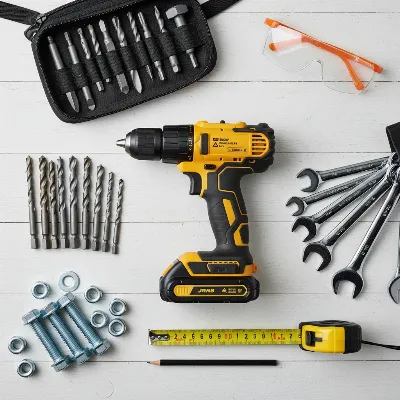 An assortment of tools and materials for attaching a bench grinder, including drill, bolts, wrenches, and safety gear, laid out on a clean workbench.
Securing the Bench Grinder
Carefully place the bench grinder back onto your workbench, aligning the holes in its base with the holes you’ve just drilled. Insert the chosen bolts through the grinder’s base and down through the workbench. From the underside of the workbench, place a flat washer onto each protruding bolt, followed by a lock washer (if using), and then a nut. Hand-tighten all the nuts first to ensure everything is aligned. Then, using your wrench or socket set, progressively tighten each nut, alternating between them to ensure even pressure and to prevent warping the grinder’s base or the workbench surface. The goal is a firm, immovable connection without over-tightening to the point of stripping threads or damaging components. If you opt for T-nuts, insert them from the underside of the workbench into the drilled holes before placing the grinder, providing a clean, flush mounting point from below.
Final Checks and Adjustments
Once your bench grinder is securely bolted down, conduct a thorough final inspection. Gently try to wiggle the grinder; it should feel absolutely solid with no movement. Re-check the clearances for the tool rests (1/8 inch) and tongue guard (1/4 inch) as they are critical safety features that can shift during the tightening process. Ensure they are still correctly positioned and firmly tightened. If you’ve just installed new grinding wheels, it’s good practice to perform a “ring test” by gently tapping the wheel with a plastic handle to listen for a clear ringing sound, indicating no cracks. Finally, with all checks complete, plug in the grinder and turn it on briefly, standing to the side, to ensure it runs smoothly without excessive vibration or wobbling before any actual grinding work begins.
Alternative Mounting Solutions
While permanent bolting offers the highest stability, sometimes a more flexible approach is needed, especially in smaller workshops or for specialized tasks. Several alternative methods allow for easier relocation or temporary mounting of your bench grinder.
Modular Mounting Plates: This popular method involves attaching the bench grinder to a separate, smaller mounting plate, often made of a sturdy piece of wood or metal. This plate is then secured to the workbench using bolts or heavy-duty clamps. The advantage here is versatility; you can have multiple mounting plates for different tools, or easily move the grinder to another workbench or storage when not in use. This modularity makes efficient use of limited workbench space. The key is to ensure the mounting plate itself is robust and securely attached to the main workbench to maintain stability during operation.
Quick-Release Clamps: For those who need to frequently move their grinder or prefer a non-permanent attachment, heavy-duty quick-release clamps can be a viable option, often used in conjunction with a modular mounting plate. While less stable than permanent bolting for very heavy-duty grinding, high-quality clamps can provide sufficient security for lighter tasks. Always ensure the clamps are rated for the weight and forces involved and are checked frequently for tightness.
Under-Bench Mounting: In workshops where every inch of surface space is precious, some users opt to mount their bench grinder upside down underneath the workbench. This frees up the top surface for other tasks. This method typically requires detaching the motor from its base, rotating it 180 degrees, and then securing it. While an effective space-saver, it can impact ergonomics and accessibility, making it more suitable for specific, less frequent grinding tasks.
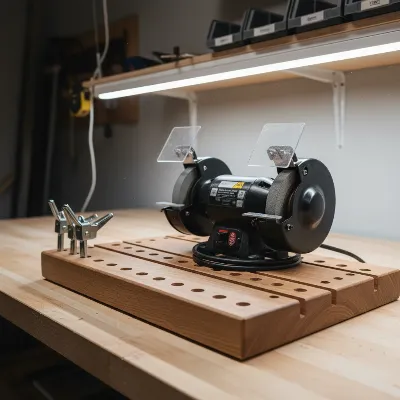 A bench grinder mounted on a modular plate, ready to be clamped or bolted to different workbench locations, illustrating flexibility and portability.
Maintenance and Best Practices for Grinder Safety
Attaching your bench grinder is just the first step; ongoing maintenance and adherence to best practices are crucial for long-term safety and performance. Regular care ensures your grinder remains a reliable tool.
- Routine Inspection: Before each use, quickly inspect the mounting bolts to ensure they are still tight. Vibration from operation can sometimes loosen fasteners over time. Also, check the grinding wheels for any chips, cracks, or excessive wear. A damaged wheel can shatter, posing extreme danger. Always replace damaged wheels immediately.
- Guard Clearances: Continuously monitor and adjust the tool rests and tongue guards as your grinding wheels wear down. Maintaining the 1/8-inch gap for the tool rest and the 1/4-inch gap for the tongue guard is critical for safety. Remember, these adjustments must only be made when the grinder is unplugged and completely stopped.
- Proper Grinding Technique: Always grind on the face (outer diameter) of the wheel, never the side, unless the wheel is specifically designed for side grinding. Avoid forcing the workpiece into the wheel; let the grinder’s speed do the work. Apply gradual pressure and move the workpiece across the entire face of the wheel to ensure even wear and prevent grooving.
- Cooling Workpieces: Metal can quickly heat up during grinding. Keep a water pot nearby to cool your workpiece, especially small tools, to prevent overheating and maintain the metal’s temper.
- Workspace Cleanliness: Grinding produces sparks and abrasive dust. Keep your workspace clean and free of flammable materials. Regularly clean around the grinder to prevent buildup of debris that could interfere with operation or pose a fire hazard. Always wear appropriate personal protective equipment, including safety glasses and hearing protection, during all grinding operations.
> “A securely mounted bench grinder isn’t just about convenience; it’s a fundamental safety measure. The stability it provides directly translates to better control and a significantly reduced risk of accidents.” – Admin, ReviewLender.com, Work Bench Technician with 10+ years experience
Conclusion
A securely attached bench grinder is an indispensable asset in any workshop, marrying enhanced safety with improved operational efficiency. By carefully following the steps for permanent bolting, or opting for a robust modular setup, you establish a solid foundation for all your grinding tasks. Beyond the initial installation, a commitment to regular maintenance and adherence to crucial safety guidelines—such as maintaining proper guard clearances and always wearing personal protective equipment—ensures your bench grinder remains a dependable and safe tool for years to come. What project will you tackle first with your newly secured bench grinder?
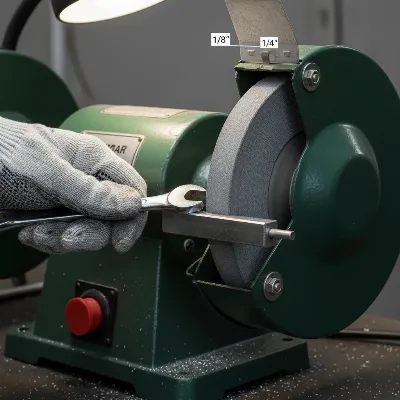 A close-up shot of a hand adjusting the tool rest and tongue guard of a bench grinder, emphasizing safety procedures and accurate spacing.
Frequently Asked Questions
How tight should I fasten my bench grinder to the workbench?
Fasten your bench grinder firmly, but avoid excessive tightening. The goal is to eliminate any movement or vibration without stripping threads or warping the grinder’s base or the workbench surface. Use a wrench or socket set to snug the nuts and bolts, ensuring even pressure across all mounting points.
Can I use C-clamps to secure my bench grinder?
While C-clamps can provide a temporary solution, they are generally not recommended for permanently securing a bench grinder due to potential instability during heavy use. For better safety and performance, consider a modular mounting plate that can be firmly clamped or bolted, offering greater surface contact and rigidity.
What safety gear is essential when using a bench grinder?
Essential safety gear includes ANSI-approved safety glasses and a face shield to protect against flying sparks and debris. Hearing protection is also crucial to guard against noise. Additionally, avoid loose clothing, jewelry, and tie back long hair to prevent entanglement with the spinning wheels.
How often should I check the mounting bolts?
It is advisable to visually inspect and check the tightness of your bench grinder’s mounting bolts before each significant use, or at least monthly if the grinder is used frequently. Vibration can cause fasteners to loosen over time, so a quick check ensures ongoing stability and safety.
Can I mount my bench grinder on a portable workbench?
Yes, a bench grinder can be mounted on a portable workbench, especially when using a modular mounting plate. Ensure the portable workbench itself is robust, stable, and rated to handle the weight and operational forces of the grinder. Always verify the stability of the entire setup before use.