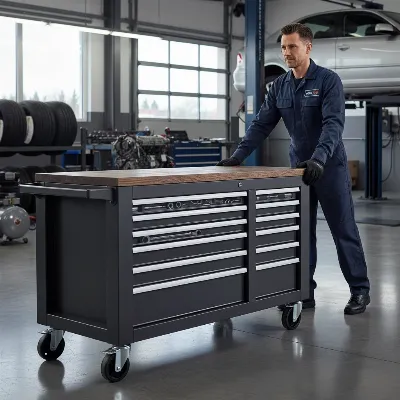
A stable and level workbench is the cornerstone of any productive garage or workshop. Without it, precision work becomes a frustrating challenge, tools might roll off, and safety can be compromised. Many garage floors are intentionally sloped for drainage, which often leaves workbenches inherently uneven. Fortunately, achieving a perfectly level workbench is a straightforward DIY project that can dramatically improve your workspace. This comprehensive guide will walk you through everything you need to know, from understanding the causes of unevenness to applying the right leveling techniques, ensuring your workbench provides a solid foundation for all your projects.
Understanding Workbench Leveling: Why It Matters
A level workbench is not just about aesthetics; it’s fundamental for safety, accuracy, and efficiency in your workspace. When your workbench wobbles or slopes, simple tasks like planing wood or assembling delicate components become significantly harder, leading to potential errors and wasted materials. Tools, especially small parts or round items, can easily roll off an unlevel surface, causing damage, loss, or even injury. Beyond the immediate frustrations, an unstable bench can also compromise the structural integrity of your projects, as measurements and cuts may be consistently inaccurate. It’s particularly important to note that most garage floors are poured with a slight slope to facilitate water drainage, meaning a workbench placed directly on such a surface will naturally lean.
Common Causes of an Uneven Workbench
Understanding why your workbench isn’t level is the first step toward fixing it. The most prevalent culprit, especially in garages, is an uneven or sloped floor. Garage floors are typically designed to direct liquids towards a drain or the garage door, making them rarely perfectly flat. This subtle gradient can cause your workbench to rock or sit lower on one side. Another common issue is the workbench itself. Over time, wood components can warp due to changes in humidity and temperature, leading to an uneven tabletop or legs. [cite: 1-workbench-top-flattening, 2-warped-top] Loose or poorly assembled joints can also contribute to instability, allowing the structure to shift and become uneven under load. Even a slight imperfection in leg length from manufacturing or DIY construction can result in a noticeable wobble.
Essential Tools for Leveling Your Workbench
Before you begin the leveling process, gather the right tools to ensure accuracy and efficiency. A spirit level is indispensable; a 2-foot or longer level will provide more accurate readings across your workbench surface than a smaller one. [cite: 1, 2-tools] For bridging larger spans, consider a 4-foot level or even a straightedge. Shims are crucial for filling gaps under legs. Options range from durable plastic shims, which are excellent for heavy benches and can be stacked without slipping, to wooden shims or even temporary cardboard pieces. [cite: 1, 4-tools]
For a more permanent and easily adjustable solution, adjustable leg levelers are highly recommended. [cite: 2-tools, 4-tools, 5-tools] If your workbench doesn’t have them, you’ll also need a drill, appropriately sized drill bits, and T-nuts for installation. A hex key or wrench will be necessary to adjust these levelers once installed. [cite: 1-tools, 2-tools, 5-tools] Other useful items include a measuring tape, a pencil for marking, and a rubber mallet for securing T-nuts or adjusting stubborn shims. If your workbench top itself is warped, a hand plane or a router sled might be needed for resurfacing. [cite: 1-flattening, 4-flattening]
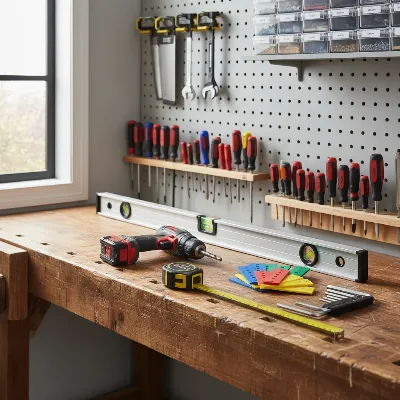 Essential tools for DIY workbench leveling including a spirit level, shims, and adjustable leg levelers.
Step-by-Step Guide to Perfectly Level Your Workbench
Leveling your garage workbench is a methodical process that ensures lasting stability and precision. Follow these steps for the best results.
Step 1: Assess the Situation
|
Our Picks for the Best Work Bench in 2026
As an Amazon Associate I earn from qualifying purchases.
|
||
| Num | Product | Action |
|---|---|---|
| 1 | Foldable Work Bench,Easy Step Protable Work Table,34" W x 25" D x 31" H Lightweight Workbench wih 1650 LBS,Work Benches for Garage,Work Bench Suitable for Garage,Workshop and Home (Green) |

|
| 2 | POWERTEC Portable Small Workbench with Vise, Imprinted Ruler and Protractor Scale, Folding Sawhorse/Worktable and 4 Bench Dogs for Woodworking Projects (MT4006V) |
|
| 3 | Express Folding Work Table, Easy Setup Portable Folding Work Table & Portable Folding Workbench, 34" W x 25" D x 31" H Lightweight Versatile Clamping Worktable for Garage/Wood Shop (Black) |
|
| 4 | Express Folding Worktable, Easy Setup Portable Folding Workbench, 34" W x 24" D Lightweight Versatile Worktable with 1650 Lbs Load Capacity Work Benches for DIY Home Improvements Professional Worksite |
|
| 5 | Heavy Duty Workbench Bracket Kit - 8 Pcs Steel 3-Way Right Angle Corner Brackets for DIY Custom Workbench, Shelving, Work Table, Fits 2x4 (Actual 1.5"x3.5") Wood |
|
| 6 | BORA Centipede 30in Folding Work Table - 48 x 96 Portable Workbench with 6000lb Capacity, 15-Strut Collapsible Work Bench for Garage, Mobile Workstation with Storage Bag - No Assembly Required CK15S |
|
| 7 | Heavyweight 2' x 4' DIY Workbench Kit with Heavy-Duty Plastic Brackets, Easy-Cut Build, Lumber Not Included, Gray |
|
| 8 | Keter Folding Work Table, Portable Workbench w/ 12" Clamps for Garage/Wood Shop - Heavy-Duty and All-Weather for DIY Home Improvements and Worksites |
|
| 9 | Seville Classics UltraHD 72" W X 25" D Wood Top Height Adjustable Workbench 2000 Lb Capacity |
|
| 10 | Bench Solutions Heavy Duty Fold Down Work Bench. |
|
Start by clearing everything off your workbench surface. Use a spirit level, placing it across the workbench in multiple directions: front-to-back, side-to-side, and diagonally across opposing corners. Observe the bubble to identify high and low spots. If the bubble is off-center, the side it leans towards is the higher side, indicating the opposite corner needs shimming or adjustment. Push down on different corners of the workbench to identify which leg or legs lift off the ground, causing a wobble. This assessment helps determine if the primary issue is the floor, the workbench structure, or both.
Step 2: Prepare Your Workbench
Before making any adjustments, ensure the workbench itself is in good condition. Check that all nuts, bolts, and screws are tight. Loose fasteners can contribute significantly to instability and rocking. If your workbench has casters, ensure they are locked or chocked, and any built-in leveling feet are initially set to their lowest position to give you maximum adjustment range. Clear any debris or small objects from underneath the workbench legs that might be interfering with a solid contact with the floor.
Step 3: Leveling with Shims
For minor unevenness or fixed-leg workbenches, shims are an effective solution. Identify the lowest corner or side using your level. Carefully lift the workbench slightly and insert shims under the low leg(s). Hard, rigid plastic shims are recommended for heavy workbenches as they can withstand significant weight and can be stacked securely due to their interlocking design. Avoid using flimsy materials like folded cardboard for permanent solutions as they can compress or degrade over time. Recheck the level after each shim adjustment, making small, incremental changes until the bubble is perfectly centered in all directions.
Step 4: Installing and Adjusting Leg Levelers
If your workbench lacks adjustable feet, installing them provides a robust and convenient leveling solution. Begin by marking the center of the bottom of each leg. Drill a pilot hole, followed by a larger hole suitable for a T-nut. [cite: 3-yt-fix-wobbly] Hammer the T-nut into place in the leg, ensuring the prongs fully embed into the wood for a secure fit. Thread the leg leveler into the T-nut. When installing all four, it’s often easiest to start with them threaded in at their lowest possible setting before flipping the workbench upright. Once the workbench is in position, use a hex key or a wrench (or even your hand for rough adjustments) to turn the leveler studs, raising or lowering each leg independently. [cite: 1-tools, 2-tools] Continually check with your spirit level, adjusting each leg until the workbench is perfectly level from side-to-side, front-to-back, and diagonally. [cite: 2-tools]
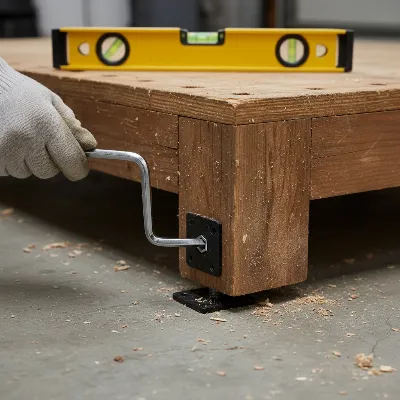 Detailed steps for installing adjustable leg levelers on a workbench for DIY enthusiasts.
Step 5: Addressing Warped Workbench Surfaces
Sometimes the issue isn’t the legs or the floor, but a warped workbench top. For minor warps, especially in solid wood, you might try a passive approach: wet the concave side (the “cupped” side) slightly and expose it to sunlight, or place heavy, flat objects on the convex side. [cite: 2-warped-top, 5-warped-top] This process can take time and may not yield perfect results. For more significant warpage, a hand plane or a router sled can be used to flatten the surface. This involves carefully shaving down the high spots until the entire surface is flat. [cite: 1-flattening, 4-flattening] If these methods are too complex, or if the warp is severe, consider adding a new, flat layer of thick plywood or MDF as a sacrificial top, screwing it down to the existing surface after shimming any major gaps underneath. [cite: 4-warped-top]
Step 6: Final Verification and Testing
After making all necessary adjustments, don’t just put your tools back and call it a day. Perform a final verification. Push firmly on all corners and edges of the workbench to ensure there is absolutely no wobble or rocking. Place a round object, like a pipe or a screwdriver, on various parts of the surface to confirm it doesn’t roll off. Run a straightedge across the surface to ensure it’s truly flat and level. If you plan to use it for specific tasks like woodworking, perform a test cut or assembly to ensure the work surface supports precision. Once confirmed, your workbench is ready for action.
Advanced Tips for Long-Term Workbench Stability
Achieving a perfectly level workbench is a great start, but maintaining its stability long-term requires a few additional considerations. One highly effective method for preventing future wobbles, especially against a garage wall, is to secure the back of the workbench to a wall stud using a level ledger board. This provides rigid support and eliminates movement from the rear. [cite: 5-leveling] Reinforcing the workbench frame with additional cross bracing or gussets can also significantly improve its overall rigidity and resistance to twisting or sagging over time.
If your workbench is mobile and uses casters, invest in heavy-duty adjustable leveling casters. These allow you to easily move the bench when needed, then lock and level it securely in place for work, providing the best of both worlds. Regularly inspect your workbench for any signs of loosening joints or new unevenness, especially if it’s subjected to heavy use or significant changes in humidity and temperature. Proactive maintenance will ensure your workbench remains a reliable and safe platform for years to come.
Conclusion
A perfectly level garage workbench is more than just a convenience; it’s a fundamental requirement for safety, precision, and efficiency in any DIY project or professional endeavor. By understanding the common causes of unevenness and employing the right tools and techniques, you can transform a wobbly, frustrating workspace into a stable, productive environment. Whether through simple shimming or installing advanced adjustable leg levelers, taking the time to properly level your workbench will undoubtedly enhance the quality of your work and your overall enjoyment. Don’t let an uneven surface undermine your craftsmanship—take control and create the solid foundation your projects deserve. What project will you tackle first on your newly leveled workbench?
Frequently Asked Questions
Why do garage floors often slope?
Garage floors are typically poured with a slight slope to facilitate drainage, directing water and other liquids away from the interior of your home and towards the garage door or a floor drain. This design prevents standing water but means the floor is inherently uneven.
What’s the best way to level a workbench on a very uneven concrete floor?
For significantly uneven concrete floors, installing adjustable leg levelers is generally the most effective and permanent solution. These allow you to precisely adjust the height of each leg independently, compensating for variations in the floor. [cite: 4-leveling-benches]
Can I use cardboard to level a workbench?
While cardboard can provide a temporary fix for minor wobbles, it is not recommended for long-term leveling. Cardboard can compress, degrade, and absorb moisture, leading to renewed instability. Durable plastic or wooden shims are much better alternatives. [cite: 1-tools]
How often should I check my workbench for levelness?
It’s a good practice to check your workbench for levelness periodically, especially if it’s subjected to heavy use, moved frequently, or if you live in an area with significant seasonal changes in humidity and temperature that can cause wood to expand or contract.