Has your trusty wooden workbench started to slump under pressure, making your projects feel a little less level? A sagging workbench can be a source of constant frustration, affecting the accuracy of your work and even posing safety risks. Whether it’s a slight dip in the middle or a more pronounced curve, understanding the root cause of your wooden workbench sagging is the first step towards a lasting solution. This article will delve into the common culprits behind a droopy work surface and provide five quick, effective fixes to restore its integrity and stability.
What Causes Workbench Sagging?
A wooden workbench’s flat top is fundamental to accurate work, so when it begins to sag, it can significantly impact your projects and efficiency. Several factors contribute to this common issue, often working in combination to compromise the bench’s structural integrity. Understanding these causes is crucial for implementing the most effective repair.
One primary reason for a sagging workbench is inadequate support. Many workbenches, especially those built for general use or from lighter materials, lack sufficient cross-bracing or a robust undercarriage. If the span between support points is too long for the material’s thickness, the top will naturally bow over time under its own weight and any added load. Similarly, weak joinery or improper leg attachment can lead to a compromised frame, allowing the entire structure to settle and sag.
Material limitations also play a significant role. While solid hardwood tops are generally more resistant to sag, thinner plywood, particle board, or medium-density fiberboard (MDF) are inherently less rigid. Particle board, for instance, requires support every 12 inches or less to prevent sagging, and even then, moisture can exacerbate the issue. These materials, when subjected to weight or environmental stresses, can deform much more readily than denser alternatives.
Excessive and uneven loads are another frequent cause. Workbenches are designed to hold tools and materials, but consistently placing heavy objects in the center or overloading the bench beyond its intended capacity will inevitably lead to deformation. Over time, this concentrated stress can permanently alter the shape of the workbench top and even compromise the frame.
Environmental factors, particularly humidity, can profoundly impact wooden workbenches. Wood is a hygroscopic material, meaning it absorbs and releases moisture from the air. Significant fluctuations in humidity can cause wood to swell, shrink, cup, or warp. This movement, when uneven, can put immense stress on the workbench components, potentially leading to a sag even in well-constructed benches. A workbench top that was perfectly flat a year ago might show signs of cupping or sagging due to changes in its surrounding environment.
Finally, poor construction techniques during the initial build can lay the groundwork for future sagging. This includes issues like open glue seams, insufficient clamping time during glue-ups, or “glue starved” joints, where not enough adhesive was applied. Furthermore, an unlevel initial build, where support posts or legs are not precisely the same length, can create inherent weak points that contribute to the entire frame sagging in the middle.
5 Quick Fixes for a Sagging Wooden Workbench
Addressing a sagging wooden workbench doesn’t necessarily mean starting from scratch. Often, a few strategic reinforcements and adjustments can restore its flat, sturdy surface. Here are five quick fixes you can implement to bring your workbench back to optimal condition.
Reinforce the Underside with a Stiffener or Apron
|
Our Picks for the Best Work Bench in 2026
As an Amazon Associate I earn from qualifying purchases.
|
||
| Num | Product | Action |
|---|---|---|
| 1 | Seville Classics UltraHD 72" W X 25" D Wood Top Height Adjustable Workbench 2000 Lb Capacity |

|
| 2 | Express Folding Worktable, Easy Setup Portable Folding Workbench, 34" W x 24" D Lightweight Versatile Worktable with 1650 Lbs Load Capacity Work Benches for DIY Home Improvements Professional Worksite |
|
| 3 | POWERTEC Portable Small Workbench with Vise, Imprinted Ruler and Protractor Scale, Folding Sawhorse/Worktable and 4 Bench Dogs for Woodworking Projects (MT4006V) |
|
| 4 | BORA Centipede 30in Folding Work Table - 48 x 96 Portable Workbench with 6000lb Capacity, 15-Strut Collapsible Work Bench for Garage, Mobile Workstation with Storage Bag - No Assembly Required CK15S |
|
| 5 | Express Folding Work Table, Easy Setup Portable Folding Work Table & Portable Folding Workbench, 34" W x 25" D x 31" H Lightweight Versatile Clamping Worktable for Garage/Wood Shop (Black) |
|
| 6 | Keter Folding Work Table, Portable Workbench w/ 12" Clamps for Garage/Wood Shop - Heavy-Duty and All-Weather for DIY Home Improvements and Worksites |
|
| 7 | Heavyweight 2' x 4' DIY Workbench Kit with Heavy-Duty Plastic Brackets, Easy-Cut Build, Lumber Not Included, Gray |
|
| 8 | Heavy Duty Workbench Bracket Kit - 8 Pcs Steel 3-Way Right Angle Corner Brackets for DIY Custom Workbench, Shelving, Work Table, Fits 2x4 (Actual 1.5"x3.5") Wood |
|
| 9 | Bench Solutions Heavy Duty Fold Down Work Bench. |
|
| 10 | Foldable Work Bench,Easy Step Protable Work Table,34" W x 25" D x 31" H Lightweight Workbench wih 1650 LBS,Work Benches for Garage,Work Bench Suitable for Garage,Workshop and Home (Green) |
|
One of the most effective ways to combat sag in a wooden workbench top is to add structural reinforcement directly beneath it. This can involve installing a stiffener or an apron. Think of it like adding extra ribs to a weak ceiling; these elements provide additional support across the span of the workbench. You can create a support frame under the seat of a sagging wood bench, typically resembling a grid with side rails, under-plank support rails, and bracing blocks. For a typical workbench, consider screwing and gluing a stout 2×4 or a piece of thicker plywood (¾-inch or more) perpendicular to the direction of the sag, running from front to back, or creating a grid of supports every 12-16 inches. Attaching these stiffeners securely to the underside of the top and connecting them to the main frame or legs will significantly increase the top’s rigidity and distribute weight more effectively. For heavier duty applications, a metal angle iron or C-channel can be bolted to the underside for unparalleled stiffness.
 Man installing a wooden stiffener beam under a sagging wooden workbench top with screws.
Strengthen the Legs and Frame
The foundation of your workbench is just as important as the top. If the legs or the main frame are wobbly, weak, or not plumb, the entire bench will struggle to support weight evenly, leading to sag. Reinforcing these elements can dramatically improve stability. Add diagonal cross-braces between the legs on the back and sides of the workbench to prevent racking and bowing. These can be made from 2x4s, plywood gussets, or even metal brackets. If your workbench uses half-lap joints for its support structure, ensure these are robust and well-secured, as they contribute significantly to the overall stability. For existing weak joints, consider adding corner brackets or stronger fasteners. Ensuring the legs are firmly anchored and free from movement will transfer loads more efficiently to the floor, reducing stress on the top.
Upgrade or Add a Layer to the Workbench Top
Sometimes, the original workbench top material simply isn’t robust enough for the demands placed upon it. One of the simplest and most effective upgrades is to add a second layer of material. For instance, if you have a ¾-inch plywood top that’s sagging, adding another ¾-inch layer of plywood on top, securely glued and screwed, will effectively double its thickness and rigidity. For a stout worktop that shouldn’t sag, use two layers of ¾-inch plywood. This creates a much stronger, more resilient surface capable of handling heavier loads without bowing. Alternatively, if your budget allows, consider replacing the top entirely with a thicker, denser material like solid hardwood (e.g., maple butcher block) or Baltic birch plywood, which offers superior stability and impact resistance. While particle board will eventually succumb to the same forces, two layers of ¾-inch exterior-grade plywood provide a more robust solution.
Redistribute and Manage Workbench Loads
Even the strongest workbench can sag if weight is consistently concentrated in one area. Proper load management is a free and effective fix for preventing and mitigating sag. Avoid habitually placing your heaviest tools or materials in the exact center of the workbench, as this is where the unsupported span is longest and stress is greatest. Instead, distribute heavy items more evenly across the surface. Utilize under-bench shelving or storage solutions for bulky tools and supplies, keeping the workbench top clear for active work. If you frequently work with exceptionally heavy components, consider temporarily reinforcing the area directly beneath them with temporary supports or blocks placed on the floor. Regularly clearing clutter also helps reduce the overall weight on the workbench, prolonging its life and maintaining its flat surface.
Level the Workbench Properly
An often-overlooked factor contributing to perceived or actual workbench sag is an uneven or unstable base. If your workbench is sitting on an uneven floor, or if its legs are not all making firm contact, the entire structure can be thrown off balance, creating points of stress that lead to bowing. Check your workbench with a long level, both front-to-back and side-to-side. If it’s not level, use shims under the legs to stabilize it. Many modern workbenches also come with adjustable leveling feet, which allow for fine-tuning on irregular surfaces. Even if your workbench frame has sagged in the middle, raising the center section and letting it settle over time can help eliminate the sag. Ensuring your workbench is perfectly level distributes the load uniformly across all support points, preventing localized stress and contributing significantly to the overall stability and longevity of your work surface.
Preventing Future Workbench Sagging
Preventing workbench sagging in the first place, or ensuring it doesn’t return after repairs, involves a combination of smart design choices, diligent usage, and environmental awareness. A proactive approach saves time and effort in the long run, ensuring your workspace remains a reliable foundation for all your projects.
Firstly, design for durability from the outset. When building or purchasing a new workbench, prioritize robust materials and a sturdy support structure. Opt for thicker workbench tops, such as solid hardwood, laminated layers of high-quality plywood (like Baltic birch), or even a combination with a steel frame for ultimate strength. For wooden tops, ensure adequate framing underneath with cross-bracing spaced no more than 16-24 inches apart. The use of strong joinery methods, such as mortise and tenon, through bolts, or well-engineered pocket screws, will create a more resilient frame capable of resisting deformation over time.
Secondly, practice smart usage and maintenance. Even the most heavy-duty workbench has its limits. Always respect the bench’s intended load capacity and avoid concentrating excessive weight in one small area, especially in the center of a long span. Distribute heavy tools and materials evenly, or store them on shelves below the workbench. Regular cleaning and organization also reduce overall load and identify potential issues early. Periodically check fasteners and joints, tightening any that have loosened over time due to vibration or wood movement.
Lastly, consider environmental control. Humidity is a significant factor in wood movement, which can contribute to sagging. If your workshop experiences wide fluctuations in humidity, consider applying a good quality wood sealer or finish to all surfaces of your workbench top. This helps to stabilize the wood by slowing down the rate at which it absorbs or releases moisture, minimizing warping, cupping, and potential sagging. While complete environmental control might be impractical for some workshops, even simple measures can make a difference in preserving your workbench’s integrity.
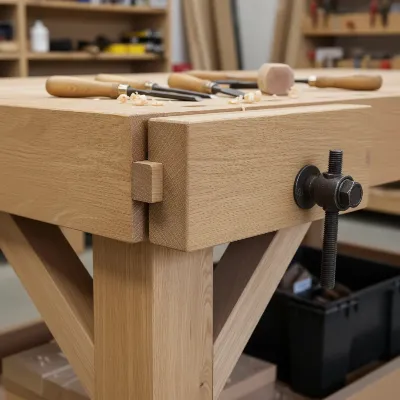 Close-up of a well-designed workbench frame with strong joinery and cross-bracing.
Conclusion
A sagging wooden workbench can be a significant impediment to accurate and efficient work, but it’s a problem that is often solvable with the right approach. From reinforcing the underside with stiffeners and strengthening the supporting frame to upgrading the top material, redistributing loads, and ensuring proper leveling, there are numerous practical steps you can take. By understanding the common causes—like inadequate support, material limitations, and environmental factors—you can implement targeted fixes that restore your workbench’s essential flatness and stability. Investing a little time in these repairs and preventative measures will ensure your workbench remains a reliable foundation for all your future projects. What project will you tackle first on your newly reinforced workbench?
Frequently Asked Questions
How thick should a workbench top be to prevent sagging?
To prevent sagging, a general-purpose wooden workbench top should typically be a minimum of 1.5 inches thick, often achieved by laminating two layers of ¾-inch plywood. For heavy-duty use or longer spans, a thickness of 2 to 4 inches of solid hardwood, laminated wood, or a butcher block style top is highly recommended for superior rigidity and load-bearing capacity.
Can humidity cause a wooden workbench to sag?
Yes, significant changes in humidity can absolutely cause a wooden workbench to sag, warp, or cup. Wood naturally expands and contracts with moisture absorption and release. If one side of the wood dries or absorbs moisture faster than the other, it creates internal stresses that can lead to deformation and sagging over time, especially if the workbench lacks adequate structural support.