A wobbly wood workbench can be stabilized by addressing uneven legs, loose joints, or insufficient bracing. Common solutions include shimming uneven legs, tightening fasteners, applying wood glue to joints, and adding diagonal bracing or plywood gussets for structural rigidity. These DIY fixes can restore stability, improve precision, and enhance safety in your workspace, often using tools and materials readily available in a home workshop.
Understanding Why Your Workbench Wobbles
Before you reach for your tools, pinpointing the exact reason your workbench lacks stability is key. A wobble isn’t always a sign of catastrophic failure; often, it’s a simple issue that can be quickly rectified.
Common Culprits Behind the Wobble
One of the most frequent reasons for an unstable workbench is an uneven floor or uneven legs. Garage floors, for instance, are often intentionally sloped to facilitate drainage, creating an inherently unlevel surface for your workbench. Even if your floor is perfectly flat, slight variations in leg length can mimic the same problem. Beyond the floor, loose joints and fasteners are significant contributors. Over time, vibrations from heavy work, repeated use, or even changes in humidity can cause screws to loosen, bolts to back out, or glue joints to fail. Lastly, poor initial construction or insufficient bracing can doom a workbench to instability from the start. A design that relies on single fasteners at critical points, uses thin materials, or lacks adequate diagonal support is prone to “racking,” a term for the sideways shifting of the frame. Sometimes, a workbench might even have a subtle twist in its frame introduced during assembly.
Diagnosing the Root Cause
Identifying the specific type of wobble will guide your repair strategy. Start by moving your workbench to a known flat surface, if possible, to rule out floor irregularities. Once in place, gently push down on each corner of the workbench one by one. If two opposing legs lift off the ground simultaneously when you push on a corner, the issue is primarily uneven legs or an unlevel floor. If, however, the entire workbench frame shifts or “racks” from side to side without the legs lifting, it indicates structural instability due to loose joints or insufficient bracing. This “parallelogramming” motion means the rectangular joints are failing to hold their square shape. Also, inspect all visible fasteners for looseness and check for any signs of cracking or separation in the wood joints.
Essential Tools and Materials for Workbench Stabilization
Having the right arsenal of tools and materials on hand will make the repair process smoother and more effective. Many of these items are likely already in your home workshop.
Basic Diagnostic and Adjustment Tools
|
Our Picks for the Best Work Bench in 2026
As an Amazon Associate I earn from qualifying purchases.
|
||
| Num | Product | Action |
|---|---|---|
| 1 | BORA Centipede 30in Folding Work Table - 48 x 96 Portable Workbench with 6000lb Capacity, 15-Strut Collapsible Work Bench for Garage, Mobile Workstation with Storage Bag - No Assembly Required CK15S |

|
| 2 | Heavy Duty Workbench Bracket Kit - 8 Pcs Steel 3-Way Right Angle Corner Brackets for DIY Custom Workbench, Shelving, Work Table, Fits 2x4 (Actual 1.5"x3.5") Wood |
|
| 3 | Express Folding Work Table, Easy Setup Portable Folding Work Table & Portable Folding Workbench, 34" W x 25" D x 31" H Lightweight Versatile Clamping Worktable for Garage/Wood Shop (Black) |
|
| 4 | Seville Classics UltraHD 72" W X 25" D Wood Top Height Adjustable Workbench 2000 Lb Capacity |
|
| 5 | Foldable Work Bench,Easy Step Protable Work Table,34" W x 25" D x 31" H Lightweight Workbench wih 1650 LBS,Work Benches for Garage,Work Bench Suitable for Garage,Workshop and Home (Green) |
|
| 6 | Keter Folding Work Table, Portable Workbench w/ 12" Clamps for Garage/Wood Shop - Heavy-Duty and All-Weather for DIY Home Improvements and Worksites |
|
| 7 | Heavyweight 2' x 4' DIY Workbench Kit with Heavy-Duty Plastic Brackets, Easy-Cut Build, Lumber Not Included, Gray |
|
| 8 | Express Folding Worktable, Easy Setup Portable Folding Workbench, 34" W x 24" D Lightweight Versatile Worktable with 1650 Lbs Load Capacity Work Benches for DIY Home Improvements Professional Worksite |
|
| 9 | POWERTEC Portable Small Workbench with Vise, Imprinted Ruler and Protractor Scale, Folding Sawhorse/Worktable and 4 Bench Dogs for Woodworking Projects (MT4006V) |
|
| 10 | Bench Solutions Heavy Duty Fold Down Work Bench. |
|
For diagnosing unevenness, a spirit level (preferably a longer one) and a measuring tape are indispensable. To tighten fasteners, you’ll need a variety of screwdrivers (Phillips, flathead, square drive) and wrenches (adjustable or a socket set) for bolts. A rubber mallet or hammer can be useful for gently seating components or tapping shims. Finally, a set of wood clamps will prove invaluable for holding components tightly together while glues dry or fasteners are installed.
Reinforcement Components and Adhesives
To combat unevenness, prepare wood shims (thin tapered pieces of wood) or invest in durable plastic shims like Wobble Wedges. For a more permanent and adjustable solution, adjustable leveling feet are an excellent upgrade. To reinforce loose joints, consider L-brackets or metal corner braces for external support, or plywood/MDF scraps cut into triangular gussets for internal bracing. No workbench repair kit is complete without a high-quality wood glue. PVA glues like Titebond II or Titebond III are excellent for wood-to-wood bonds, with Titebond III offering superior water resistance. For gap-filling in looser joints or bonding dissimilar materials like wood to metal, a strong epoxy is recommended. Finally, have an assortment of screws (wood screws, lag screws) and bolts with washers and nuts ready for adding new, stronger connections.
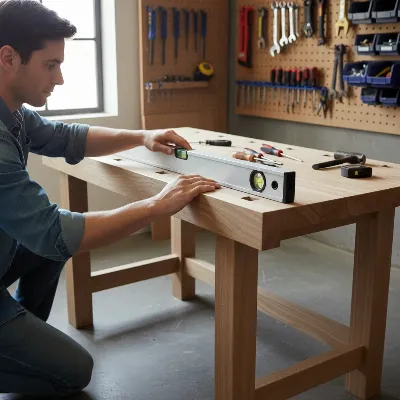 A person using a spirit level to diagnose a wobbly wooden workbench, highlighting uneven legs.
Step-by-Step DIY Solutions for a Stable Workbench
With your diagnosis complete and tools at the ready, it’s time to transform that shaky workstation into a steadfast platform.
Addressing Unevenness and Unlevel Floors
If your workbench’s primary issue is an uneven stance, start by identifying the shortest leg or the lowest point. Using shims is the quickest fix. Slide wood or plastic shims under the offending leg(s) until the workbench is level. Plastic shims, often with interlocking ridges, are particularly durable for permanent solutions and can be stacked safely for larger gaps. For a more sophisticated and easily adjustable solution, installing adjustable leveling feet is highly recommended. These feet often feature an L-shaped bracket that mounts to the bottom of the workbench legs, allowing you to fine-tune each leg’s height with a wrench or hex key. If you’re confident in your woodworking skills and your floor is level, you might choose to trim uneven legs. This requires precise measurement and careful cutting to ensure all four legs are exactly the same length.
Tightening and Reinforcing Loose Joints
Loose joints are a common culprit for racking wobbles. Begin by retightening all existing fasteners. Use the appropriate screwdriver or wrench to ensure every screw and bolt is snug. Be careful not to overtighten and strip the wood. If existing screws no longer hold firmly, consider replacing them with longer, thicker screws or pre-drilling and installing lag screws or bolts with washers for maximum clamping force. For wooden joints that have separated or become weak, applying wood glue can dramatically improve stability. Disassemble the joint if possible, clean out any old glue or debris, apply a generous amount of high-quality wood glue (like Titebond III) to both mating surfaces, then reassemble and clamp tightly until the glue fully cures. For external reinforcement, L-brackets or metal corner braces can be screwed into the inside corners of the frame where legs meet aprons, providing a strong mechanical connection.
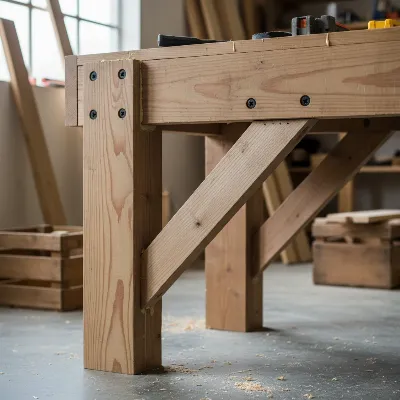 A close-up view of a wooden workbench leg with diagonal bracing added for stability, showcasing a DIY fix.
Enhancing Structural Rigidity with Bracing
To effectively combat racking, you need to introduce triangular support into the rectangular frame of your workbench. Adding diagonal bracing or stretchers is an excellent method. These can be made from 1x3s, 2x2s, or even sturdy metal strapping, installed at an angle between the legs and horizontal frame members. They prevent the rectangle from deforming into a parallelogram. Similarly, installing plywood gussets (triangular pieces of plywood or MDF) securely screwed and glued into the inside corners of the workbench frame provide immense shear strength. For even greater rigidity, a full back panel or side panels made from plywood or MDF, securely fastened to the legs and aprons, can virtually eliminate racking by creating a solid box structure. For a stationary workbench that won’t be moved, bolting it to a wall is one of the most effective ways to achieve ultimate stability. Use lag screws to secure the workbench’s frame directly to wall studs.
Comparative Overview of Stabilization Techniques
Choosing the right technique depends on the nature of your wobble, your budget, and the desired level of permanence. Here’s a quick comparison to help you decide:
| Technique | Difficulty | Cost (Approx.) | Effectiveness | Best For |
|---|---|---|---|---|
| Shimming Legs | Easy | Low | Moderate | Quick, temporary, or semi-permanent fix for floor unevenness. |
| Installing Leveling Feet | Medium | Medium | High | Adjustable, permanent solution for uneven floors and minor height adjustments. |
| Tightening Fasteners | Easy | Low | Moderate | Resolving minor wobbles due to loose hardware. |
| Applying Wood Glue | Medium | Low | High | Permanently strengthening loosened or separated wood joints. |
| L-Brackets/Corner Braces | Easy/Medium | Low/Medium | Medium/High | Quick external reinforcement for existing joints. |
| Adding Diagonal Bracing | Medium | Medium | High | Significantly reducing racking (side-to-side wobble). |
| Plywood Gussets/Panels | Medium | Medium | High | Comprehensive anti-racking and overall structural integrity. |
Preventing Future Wobbles: Maintenance and Best Practices
Once your workbench is stable, a little proactive maintenance can ensure it stays that way for years to come.
Regular Inspections and Prompt Action
Make it a habit to regularly inspect your workbench for any signs of instability. This could be before a major project, or perhaps quarterly. Check all screws and bolts for tightness, look for any new gaps or cracks in glued joints, and verify the workbench’s levelness. Addressing small issues as they arise will prevent them from escalating into larger, more complex repairs. A quick check with a level and a twist of a wrench can save you significant time and effort down the line.
Building for Stability from the Start
If you’re ever building a new workbench or modifying an existing one, incorporate design principles that prioritize stability. Using robust joinery, such as mortise and tenon or heavy-duty through-bolts, creates inherently stronger connections than simple butt joints with screws. Selecting appropriate wood dimensions, opting for beefier legs and thicker aprons, naturally enhances stiffness. Most importantly, incorporating diagonal bracing or full plywood panels into the design from the outset will prevent racking before it ever becomes a problem, ensuring your workbench is truly rock-solid from day one.
Top DIY Products for Workbench Stabilization
For those looking to purchase specific items to stabilize their workbench, here are some highly effective options popular among DIYers:
- Adjustable Workbench Leveling Feet: Brands like WEN and Fulton offer heavy-duty leveling feet with L-shaped brackets that attach securely to the workbench legs, allowing for easy, precise height adjustments to compensate for uneven floors. Generic heavy-duty options with M12 threads are also widely available and effective.
- High-Quality Wood Glue: Titebond III Ultimate Wood Glue is a favorite for its exceptional strength, water resistance, and longer open time, making it ideal for reinforcing joints. Gorilla Wood Glue is another strong PVA-based option. For larger gaps, a two-part epoxy system provides excellent structural integrity.
- Heavy-Duty Metal L-Brackets or Corner Braces: These simple yet effective reinforcements can be found at any hardware store. Look for thick-gauge steel brackets with multiple screw holes for maximum holding power when reinforcing internal or external corners.
- Plywood or MDF Sheets: Investing in a sheet of 1/2-inch or 3/4-inch plywood or MDF can provide ample material for cutting custom gussets or full back/side panels to significantly stiffen your workbench frame.
- Assorted Lag Screws and Bolts: Keep a variety of sizes of lag screws and corresponding bolts with washers and nuts on hand. These provide superior clamping force compared to standard wood screws, especially in high-stress joints.
Conclusion
A stable workbench is the cornerstone of any productive and safe home workshop. By systematically diagnosing the cause of the wobble, whether it’s uneven legs, loose joints, or inadequate bracing, you can implement effective DIY solutions ranging from simple shimming and tightening to more robust bracing and glue applications. Investing a little time and effort now to stabilize your workstation will pay dividends in improved precision, enhanced safety, and a more enjoyable woodworking experience. A sturdy workbench isn’t just a convenience; it’s an essential partner in bringing your creative projects to life.
What’s your go-to quick fix for a wobbly workbench that always saves the day?
Frequently Asked Questions
Can a wobbly workbench be dangerous?
Yes, a wobbly workbench poses several hazards. Tools can roll off and be damaged or cause injury, and a rocking bench can lead to accidental cuts or impacts, particularly when using hand planes or power tools that require a stable surface for safe operation.
How do I know if my workbench wobble is due to uneven legs or loose joints?
To diagnose, place the workbench on a level surface. Push down firmly on each corner diagonally opposite to another. If two legs lift off the ground, it’s an unevenness issue. If the frame visibly shifts or “racks” without the legs lifting, the problem lies in loose joints or inadequate structural bracing.
What kind of wood glue is best for strengthening workbench joints?
For robust wood-to-wood bonds, PVA glues like Titebond II or Titebond III (the latter for its enhanced moisture resistance) are excellent choices. If there are larger gaps in the joints that need filling for structural integrity, a strong two-part epoxy adhesive is highly recommended for its gap-filling properties.
Can I use shims permanently to fix an uneven workbench?
Yes, specially designed plastic shims, often with interlocking features, can provide a durable and permanent solution for leveling a workbench on an uneven floor. For wooden shims, ensure they are securely glued or fastened in place to prevent them from shifting or falling out over time.
Is it better to bolt a workbench to the wall or add weight?
Both methods enhance stability, and their suitability depends on your needs. Bolting a workbench to the wall provides superior anti-racking stability, ideal for stationary setups. Adding weight to lower shelves, such as concrete pavers, helps reduce overall movement, especially beneficial for workbenches that need to remain mobile or cannot be attached to a wall.
What is “racking” in a workbench?
Racking describes the sideways or parallelogram-like distortion of a workbench’s frame when subjected to horizontal forces. This instability occurs when the rectangular joints connecting the legs and stretchers lack sufficient rigidity, often due to weak fasteners, inadequate glue, or the absence of diagonal bracing.
How often should I check my workbench for stability?
It’s a good practice to perform a quick stability check before starting any significant project on your workbench. A more thorough inspection of all fasteners, joints, and overall levelness should be done quarterly, or immediately if you notice any new wobbles or shifts during use.
Fix a Wobbly Wood Workbench
This guide provides step-by-step DIY solutions to diagnose and fix instability in a wobbly wood workbench, addressing unevenness, loose joints, and structural rigidity.
Identify the shortest leg or lowest point of your workbench. Use wood or plastic shims under the uneven leg(s) until the workbench is level. For a more permanent solution, install adjustable leveling feet to fine-tune each leg's height.
Retighten all existing screws and bolts, replacing any stripped ones with longer, thicker screws or lag screws. For separated wooden joints, apply high-quality wood glue like Titebond III to mating surfaces, then clamp tightly until cured. Add L-brackets or metal corner braces for external reinforcement.
Combat racking by adding diagonal bracing (e.g., 1x3s, 2x2s, or metal strapping) between legs and horizontal frame members. Alternatively, install plywood gussets (triangular pieces) in inside corners or attach full back/side panels of plywood or MDF for a solid box structure. For ultimate stability, bolt the workbench to a wall using lag screws into studs.

I tried the wood glue method on some of my loose joints, and while it helped a bit, the wobble is still there, just not as bad. I think my issue might be more with the uneven legs on my garage floor, which is sloped. I’ll have to try shimming next, but I was hoping the glue alone would do the trick.
This was super helpful! My workbench has been a hazard for a while, and I was worried I’d have to buy a new one. The idea of adding diagonal bracing was a game-changer for me. It was a straightforward fix with materials I already had, and now my workspace feels so much safer and more functional. Highly recommend trying these solutions.
My workbench had a slight wobble that was driving me crazy, especially when I was trying to do more precise work. I tried tightening all the fasteners first, and that actually fixed most of the issue. It’s much more stable now, and I didn’t even need to buy anything extra. Good to know about the shimming trick for next time though.
I was about to give up on my old workbench, it was so wobbly I couldn’t even plane a board without it shaking. The tip about adding plywood gussets really saved it. I had some scrap plywood lying around and it made a huge difference in rigidity. Now it feels solid as a rock, wish I’d thought of this sooner!